One challenge. Many solutions.
The missions are fixed, but the strategy is yours. Teams spend the season designing, testing and improving before bringing their work to ECER.
- Read the challenge. Each January brings a new field, missions, scoring rules and construction limits.
- Design and build. Choose a strategy, construct your robots and test one idea after another.
- Program autonomy. Sensors, cameras and student-written code control every movement. There is no driver during a Botball match.
- Hands off. Robots enter their starting areas. Once the match begins, the program has to do the work.
- Score and improve. Judges score the completed missions. Teams return to the pit, make changes and try again.
Score on the game table

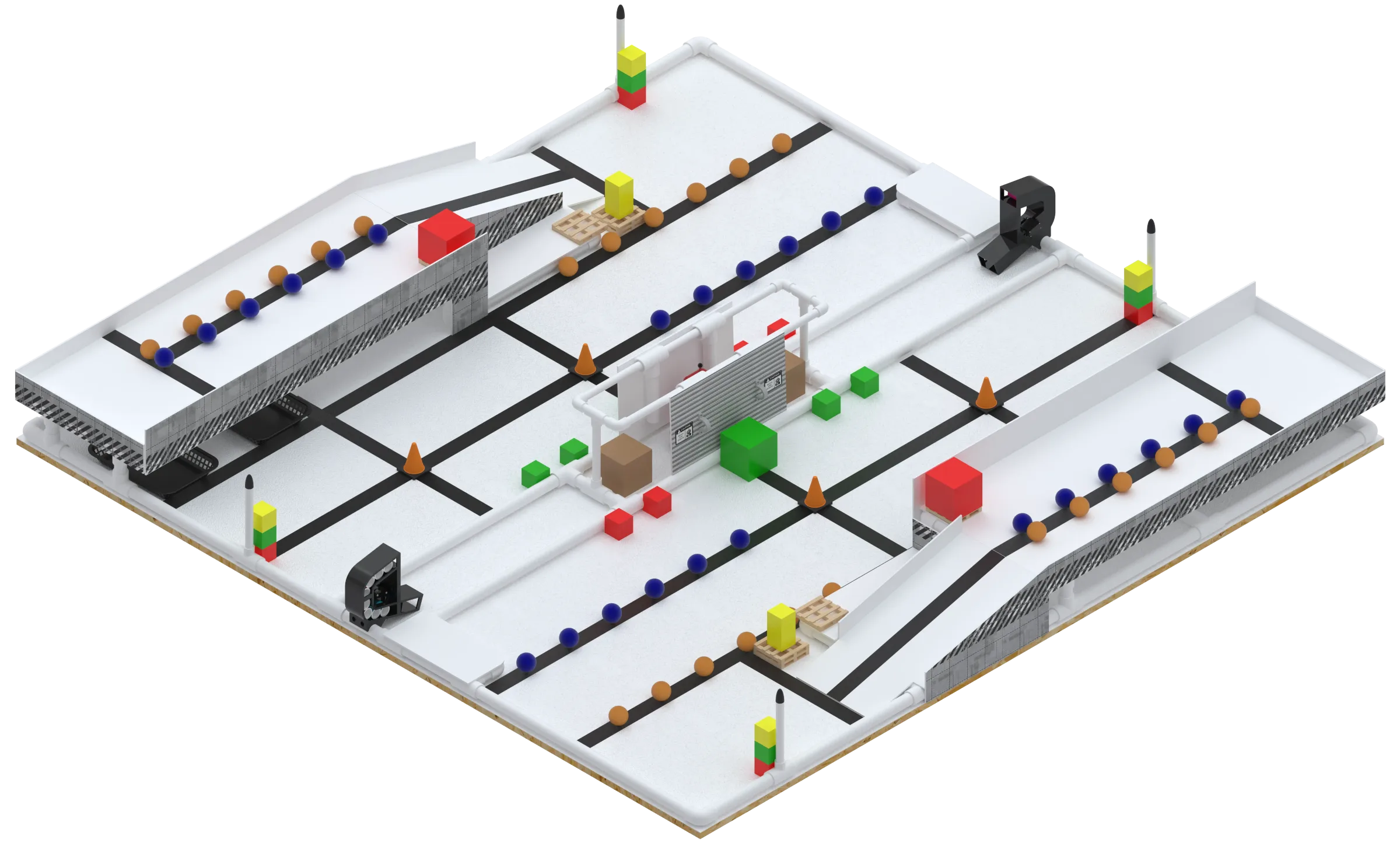
Botball and ECER Open play the same game. Botball uses a standardised kit; Open has no hardware limits. Robots begin inside defined starting areas, then collect, sort, stack or deliver game pieces to earn points. The exact objects and scoring zones change every year.
The 2026 example uses 120-second matches, two robots per Botball team and no drivers after the start. The current season’s rulebook is authoritative for the current event.
Black lines help robots navigate. Coloured objects can be moved into scoring positions. Ramps, raised areas and the shared centre create mechanical and strategic problems. Teams choose routes, prioritise points and plan for another team during head-to-head rounds.
Find every scoring area and game piece
Switch between the two layers, then select an outlined part of the field to understand what it does. Several copies of the same object are highlighted together.
This is the official 2026 Stack Attack field, an example of how a Botball challenge is documented. It is not the current season’s challenge.
Select an outline or use Tab to explore. Select it again or press Escape to clear the selection.
Read the official 2026 game review · Download the official 3D model (78 MB)
See the game. Count the points.
KIPR’s official 2026 video introduces the Stack Attack theme and its missions. It is a short cinematic overview, while the score sheet shows exactly how a judge turns each final game-piece position into points.
Both resources describe the 2026 KIPR game. ECER amendments and each season’s rulebook remain authoritative for their respective events.
Where the points come from
Judges count game pieces in each scoring area, apply the listed point values and calculate any multipliers. Teams can use the same sheet during testing to compare strategies.

The code is the driver
A Botball team receives the same core kit as every other team and builds two autonomous robots. Cameras, distance sensors, motors and mechanisms are useful, but the challenge is combining them into a reliable strategy.
The tournament starts with unopposed seeding rounds. The best two of three scores determine the seed. Teams then meet in a double-elimination bracket, where the higher score wins each match. Documentation and engineering awards recognise more than the final ranking.
Explore Botball · Compare ECER Open
Document the engineering, not just the robot
Botball teams submit project documentation during the build season and present their engineering onsite. It is required work and contributes to the regional tournament score.
The following are 2026 example rubrics. Current ECER P1, P2, P3 and 3D-file deadlines are still to be confirmed. Check the current deadlines before submitting.
- P1
PDF + online quiz
Plan the season
Decide how the team will work, which game goals matter and how progress will be tracked.
- Team roles, organiser and checkpoints
- Strategy, documentation and outreach goals
- Game review and rules quiz
Open P1 rubric
- P2
2–4 minute video + code
Prove the process
Show how the robots work and how testing changed the design, mechanism or program.
- Effectors, mechanisms and clear robot views
- Testing data and improvements
- Readable, commented code
Open P2 rubric
- P3
Form + checklist + STL files
Finish match-ready
Close the loop with team feedback, outreach evidence and a reliable setup process.
- Outreach evidence and team survey
- 90-second robot setup checklist
- Every custom 3D-printed part used onsite
Open P3 rubric
Tell the engineering story
A 6-minute talk and 4-minute Q&A connect the first idea, the failed attempts and the final strategy.
- Up to four student presenters
- Strategy, mechanical and programming growth
- At least four useful visuals, models or graphs
Open onsite rubric
Photograph prototypes and failed ideas, keep code readable and versioned, and record test results while the decisions are still fresh.
Check deadlines